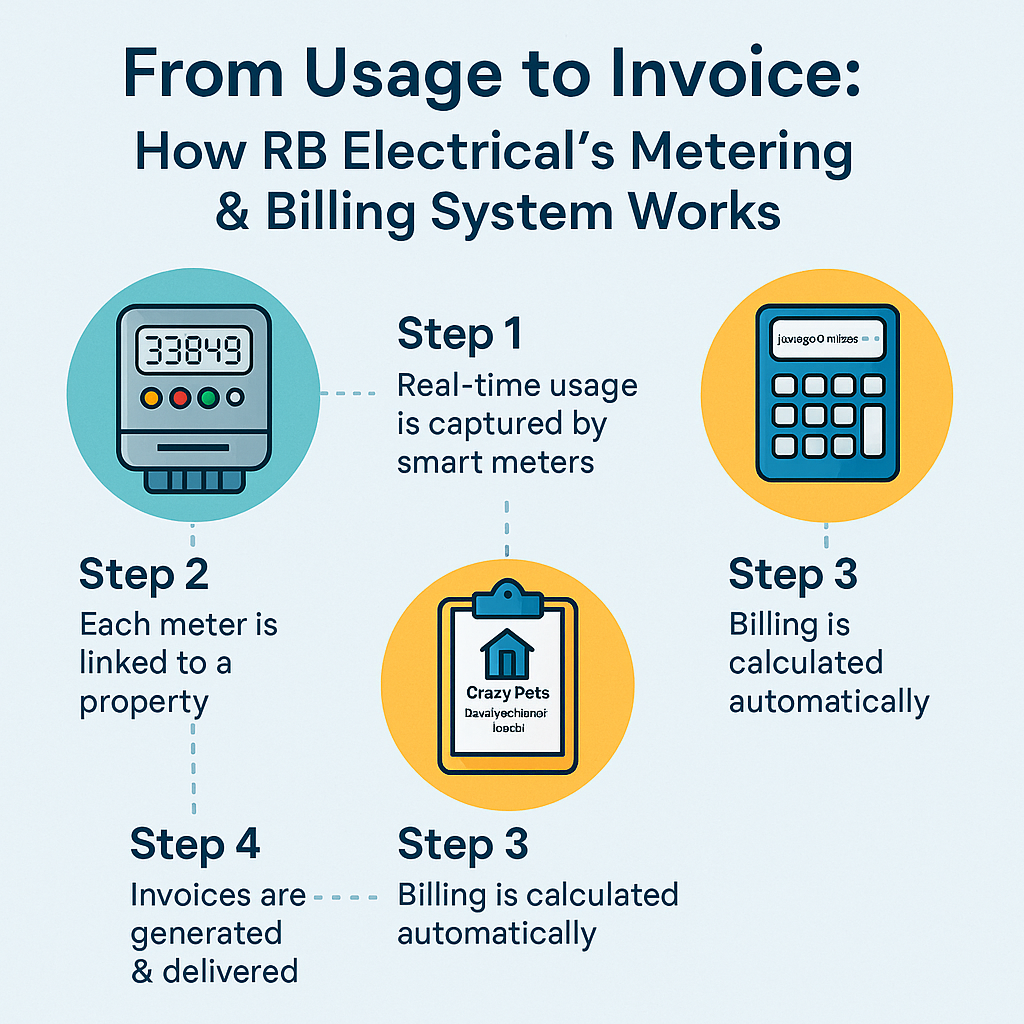
Month-end utility billing can become stressful when meter readings are late, tariffs have changed, tenants query invoices or consumption looks unusual. For landlords, estate managers and managing agents, the risk is not only sending an incorrect invoice. Poor records can lead to disputes, delayed recoveries and a loss of trust between landlord and tenant.
A landlord utility billing checklist creates a repeatable process. It helps you move from meter readings to tenant invoices with fewer gaps and better evidence. The process below applies to residential and commercial properties, estates, farms and multi-tenant sites where electricity or water costs are recovered from occupants.
RB Electrical supports smart electricity and water metering, per-tenant utility billing, usage reporting and RBE Utilities monitoring powered by the MY.POWER platform. The practical goal is consistent billing backed by reliable data.
Step 1: Confirm the billing period
Before looking at consumption, confirm the exact start and end dates. Many disputes begin because the invoice period does not match the reading period.
Check:
- Opening reading date and closing reading date.
- Number of days in the billing period.
- Whether the period matches the landlord’s account or tenant agreement.
- Whether any estimated readings were used.
- Move-in, move-out or vacancy dates.
If the period is unusual, add a note before invoices are issued. A 35-day billing period will not compare fairly with a 30-day month unless the difference is explained.
Step 2: Verify meter data
Meter data should be checked before calculations are finalised. Manual readings can be typed incorrectly, photographed poorly or assigned to the wrong tenant. Automated readings reduce this risk, but exception checks are still important.
Verify:
- Meter number or tenant reference.
- Opening and closing readings.
- Units of measure, such as kWh or kilolitres.
- Reading sequence, ensuring the closing reading is higher unless a meter rollover or reset is documented.
- Any zero usage, negative usage or unusually high usage.
For multi-tenant sites, compare sub-meter totals with the main meter where practical. Differences may be expected because of common areas, losses, timing or unmetered loads, but large unexplained gaps should be investigated.
Step 3: Check tariffs, fixed charges and billing rules
The reading is only one part of the invoice. Tariffs and billing rules must also be correct.
Review:
- Current electricity and water tariffs used for recovery.
- Fixed charges, basic charges or agreed admin charges.
- VAT treatment where applicable to the billing arrangement.
- Common-area allocations.
- Minimum charges or special lease provisions.
- Any corrections from previous months.
Do not change billing rules informally from month to month. If a lease or management agreement defines the method, keep the calculation aligned with that agreement and maintain records of changes.
Step 4: Identify unusual consumption before invoices go out
It is easier to handle abnormal consumption before invoices are sent. Once a tenant receives a high bill, the conversation becomes more difficult.
Look for:
- Sudden increases compared with the previous month.
- Consumption that does not match occupancy or trading hours.
- Continuous water flow after hours.
- Electricity use in vacant units.
- High usage after maintenance, tenant fit-outs or seasonal changes.
- Repeated estimates instead of actual readings.
If you have smart metering, review trend data and alerts. If you rely on manual readings, compare photos, dates and historical usage. The aim is not to delay billing unnecessarily, but to catch obvious problems early.
Step 5: Prepare tenant invoices with evidence
A clear tenant utility invoice should allow the tenant to understand how the amount was calculated. Attach or retain supporting information.
Useful evidence includes:
- Meter reference and location.
- Opening and closing readings.
- Reading dates.
- Consumption units.
- Tariff or billing rate.
- Fixed charges or agreed additional charges.
- Notes for estimates, corrections or abnormal readings.
This approach supports fair tenant billing and reduces repeated queries. It also helps new property managers understand previous billing decisions.
Step 6: Handle tenant queries consistently
Tenant queries should be answered with records, not assumptions. A good process protects both the landlord and the tenant.
When a tenant queries a bill:
- Confirm the meter assigned to the tenant.
- Recheck opening and closing readings.
- Compare usage with previous periods.
- Check for known leaks, faults, fit-outs or occupancy changes.
- Provide the calculation method and supporting data.
- Record the query, response and any adjustment.
Avoid making once-off adjustments without a reason recorded. If an error is found, correct it transparently and keep the audit trail.
Step 7: Keep records that can be audited
Utility billing records should be kept in a way that another person can review later. This is important when staff change, tenants move out or a dispute arises months after billing.
Keep:
- Monthly reading files or automated meter reports.
- Photos of manual meter readings, where used.
- Tenant schedules and meter allocation records.
- Tariff tables and billing rule changes.
- Copies of invoices and credit notes.
- Query logs and adjustment approvals.
- Notes on leaks, faults or access problems.
Copy-friendly monthly checklist
- Confirm billing start and end dates.
- Confirm all meters have readings for the correct period.
- Match every meter to the correct tenant, unit or common area.
- Check for missing, estimated, zero, negative or unusually high readings.
- Compare current use with the previous month and similar periods.
- Check water data for possible leaks or after-hours flow.
- Check electricity data for vacant-unit use or unexpected spikes.
- Confirm tariffs, fixed charges and billing rules.
- Review common-area allocations.
- Add notes for estimates, corrections or abnormal consumption.
- Prepare invoices with opening readings, closing readings and dates.
- Save reports, photos and calculation files.
- Send invoices and keep proof of delivery.
- Log tenant queries and responses.
- Review unresolved anomalies before the next billing cycle.
How automated metering and billing improves consistency
Automated metering does not remove the need for oversight, but it improves consistency. It reduces manual reading errors, provides clearer date ranges, makes exception reporting easier and helps managers answer tenant queries with data.
For landlords with multiple tenants or sites, automation can also reduce the month-end workload. Usage-to-invoice processes become more repeatable when meter data, billing rules and reporting are managed in one workflow. See our related guidance on fair tenant billing and usage-to-invoice processes.
When to call a professional
Call a professional when meter allocations are unclear, tenant billing cannot be reconciled, usage patterns suggest leaks or electrical faults, or manual processes are creating repeated disputes. A metering review can often identify whether the problem is data, installation layout or billing workflow.
Build a billing process tenants can trust
A landlord utility billing checklist is not only an admin tool. It is part of good property management. Accurate readings, consistent rules and clear evidence make tenant conversations easier and reduce the risk of avoidable disputes.
RB Electrical can assist with smart electricity and water metering, per-tenant billing workflows, usage reporting and client-facing utility information. Learn more about utility metering or contact us through the RB Electrical contact page to discuss a property.